Foreign Students Pay Up to Nine Times More for the Same AI Degree
International students pay a median 2.1 times the home fee for an AI master's at UK universities, and up to nine times the EU fee in the Netherlands. AICoursesForYou priced 530 AI programmes in 27 countries to see who pays what.
Data as of 30 October 2026
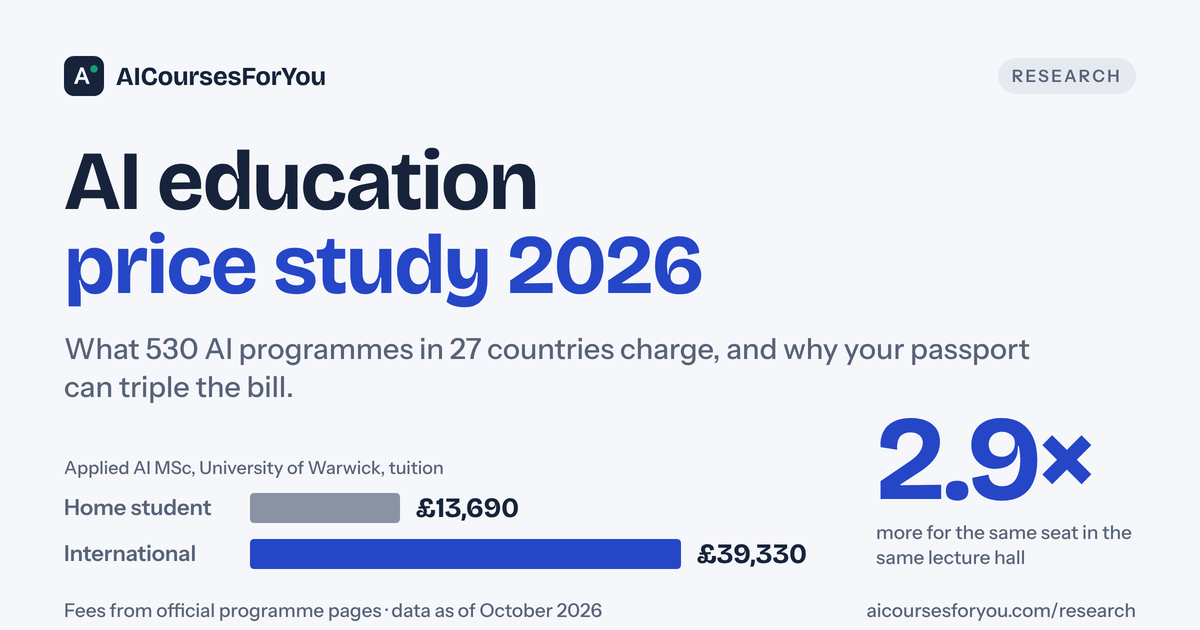
A British student starting the Applied Artificial Intelligence MSc at the University of Warwick will pay £13,690 in tuition. A classmate from India, Nigeria or the United States, on the same course and in the same lecture halls, will pay £39,330, 2.9 times more. At the University of Groningen, an EU student pays €2,771 a year for the MSc in Artificial Intelligence; a student from outside the EU pays €24,900, nine times more.
Does it matter as much where you study? Almost. An EU student can earn a two-year master’s in applied AI at Université Côte d’Azur in Nice for about €510 in registration fees, while Duke University’s online master’s in AI for product innovation costs $76,650. Between those poles sits a market with few published benchmarks, where more than half of AI master’s programmes in our database do not show a usable price on their own pages.
To map it, AICoursesForYou analysed every live listing in its database as of 30 October 2026: 1,247 AI courses and programmes, 530 of them with a price we verified on the provider’s official page. All prices were converted to US dollars at ECB reference rates of 30 October 2026.
The passport premium
Why would the same seat in the same lecture hall cost a foreign student twice as much? Because universities price two different markets. In the Netherlands and France, the state sets the fee for EU students; fees for everyone else are set by each university, and in every case in our data they are the higher of the two.
Across 26 UK AI master’s programmes that publish both fees, international students pay a median 2.1 times the home fee. At Queen’s University Belfast the ratio reaches 3.1, though its home figure is the Northern Ireland and Irish rate; students from England, Scotland and Wales pay £12,500, or 2.3 times less than international students.
Fees as quoted on each official programme page; GBP converted at the ECB rate of 30 October 2026. Ratio = international fee ÷ home fee.
The gap is wider on the continent, where EU students pay regulated fees. Dutch universities charge a non-EU student €19,555–€24,900 a year for the same MSc that costs an EU student €2,771, about 7 to 9 times more. Université Côte d’Azur charges non-EU students €3,950 a year against €255 for EU students, 15.5 times more, yet still well below most English-speaking options.
Measured against pay at home, the premium becomes a different order of magnitude. Warwick’s £13,690 home fee is 3.2 months of the average UK wage. The £39,330 international fee equals almost 20 years of India’s average wage, and the median UK international fee in our sample, £27,775, equals 14 years. Students who go abroad usually come from far above-average households, and many rely on loans or scholarships, but the comparison shows who the system is priced for.
Same degree, different postcode: a fivefold gap in tuition
Where is an AI master’s cheapest for a local student? In our data, the Netherlands. Dutch universities charge EU students the statutory fee of €2,694–€2,771 a year, so a two-year MSc costs about $6,000 in total. A one-year UK MSc costs a home student a median $17,700. In the US, where online degrees dominate our sample, the median is $33,750.
Total tuition for the whole programme as shown on official pages, home or EU fees; countries with two or more priced programmes. Sweden, which charges only non-EU students, is left out.
The spread inside countries is as telling as the gap between them. In the US, the University of Texas at Austin charges $10,000 for its online MS in AI, while Duke’s AI for Product Innovation master’s costs $76,650 and Columbia estimates about $88,715 for its online MS in Artificial Intelligence. Columbia confirmed its fees after our 30 October cut-off, so they are not in the medians. France holds both ends of the scale: public universities in Nice and Clermont-Ferrand charge EU students about €255 a year, while EDHEC’s Master in Management track in data science and AI costs €46,500.
Sweden is the extreme case. Chalmers, Uppsala, Linköping and Gothenburg charge EU, EEA and Swiss citizens nothing, and non-EU students $29,900–$38,700 for two years.
In months of pay
But is a degree that looks cheap in dollars also cheap for the person paying for it? Not always. Measured against each country’s average gross wage, a Dutch AI master’s costs a home student about one month of pay, a UK MSc about three, and a US degree almost six.
Fees in national currency ÷ OECD average annual gross wage for 2024 (Taxing Wages 2025); home or EU fees; countries with programmes from two or more institutions.
The ranking shifts once wages are counted. France’s median is 6.7 months because its English-taught grandes écoles programmes cost €21,100–€46,500 against an average wage of €44,968, while its public universities cost a few days’ pay. The one Indian master’s we could price, BITS Pilani’s online M.Tech. in AI and ML at ₹334,400, costs 16 months of India’s average wage, more than a typical US degree costs an American.
Short courses show the same pattern. India’s are the cheapest in our data in dollars, a median $56, yet that is 5.4 working days of average pay; a Dutch short course costs 3.9 days. In the US a short course or certificate costs a median 13.9 working days of pay, and in Switzerland 22.
National statistics confirm the ranking, and make the burden look heavier. The OECD measure is an average, which high earners pull up; a typical worker earns the median. Against the median full-time salary, a UK home student’s MSc costs 4.1 months of pay instead of 3.1 (ONS, £39,039 in April 2025), and a US degree 6.0 months instead of 5.7 (BLS, $1,307 a week in the third quarter of 2026). The Dutch figure stays at one month against the CBS average for full-time jobs of €66,000 in 2024.
For the people most likely to apply, the picture is milder. An American with a bachelor’s degree earns a median $1,752 a week, so the median US AI master’s costs them 4.4 months of pay.
An hour of AI training: $4.50 in India, $165 in Sweden
For most working adults the real choice is not a degree but a short course or certificate. Is a two-day workshop a better deal than a 150-hour certificate? To compare them, we divided each price by the hours of teaching or study the provider states. Across 184 such courses the median is $39 an hour.
Price ÷ stated hours of teaching or study; short courses and certificates; countries with four or more priced courses.
The cheapest hours come from large-volume providers. HCL GUVI in India sells short courses on machine learning and RAG for ₹999–₹5,500, or $2–$10 an hour; UNED in Spain charges €180 for a 150-hour certificate, $1.30 an hour. At the other end, Berghs School of Communication in Stockholm charges SEK 16,500–SEK 45,500 for 9–34 hour AI courses for marketers, designers and managers, $136–$187 an hour. These country figures reflect the providers we list, not national averages.
So is an hour in Stockholm worth 37 hours with GUVI? Not necessarily: price per hour measures cost, not quality. Format, class size and who teaches all differ, so the fair comparison is between courses that teach the same skill in the same format.
The $2,372 day: what executives pay to learn AI
What does $1,300 a day buy? Mostly access: senior faculty, a room of peers and an institution’s name. Much of the subject matter is also taught in free courses in our catalogue, as the next section shows.
Executive AI programmes for managers are the most expensive learning per hour in our data: a median $94 per hour of teaching, more than twice the rate of a typical short course. Across 21 programmes that state their length in days, the median is $1,324 per classroom day. At the top, LSE’s five-day AI-First Strategy costs £8,850, or $2,372 a day.
| Programme | Provider | Country | Fee | Days | Per day (USD) |
|---|---|---|---|---|---|
| AI-First Strategy | London School of Economics | UK | £8,850 | 5 | 2,372 |
| Executive AI Leadership Program | UNSW Sydney (AGSM) | Australia | A$13,500 | 4 | 2,371 |
| Generative AI: From Hype to Business Impact | Cambridge Judge Business School | UK | £6,250 | 4 | 2,094 |
| Leading in AI: Exploring Technology and Policy | Harvard University | US | $11,700 | 6 | 1,950 |
| AI for Leaders | Queen’s University (Smith) | Canada | C$11,000 | 4.5 | 1,750 |
| Certification en intelligence artificielle | HEC Montréal | Canada | C$5,395 | 6 | 644 |
| AI Strategy Compass voor bedrijven | Syntra AB | Belgium | €1,512 | 3 | 563 |
| Artificial Intelligence Strategy | IIM Bangalore | India | ₹125,000 | 5 | 263 |
The five dearest per day and the three cheapest. Fees as published; some include meals or accommodation (UNSW’s is residential), and VAT treatment differs by country.
The free end
So is paying for AI training worth it at all? For a first step, often not. Of the 347 online AI courses in our catalogue, 124 are free and 87 can be audited for free, 61% in all; the median course takes about five hours. For learners who want certificates, a year of Coursera Plus costs $399, less than a single day of most executive programmes above.
Public money shapes the free supply by country. Two-thirds of the courses we list in Germany and South Korea are free, thanks to the federally funded KI-Campus and the national K-MOOC platform. Brazil (65%, mostly ENAP and Fundação Bradesco) and Turkey (57%, mostly the state-run BTK Akademi) follow. In the UK, the Netherlands, Switzerland, Singapore, Australia, Spain, Austria and Portugal, none of the courses we list is free; Singapore instead subsidises paid courses through SkillsFuture credits for citizens and permanent residents, so many residents pay far less than the listed fee.
What isn’t priced
Why is it so hard to find out what an AI master’s costs? Because the least transparent part of the market is the most expensive one. For 54% of the 212 AI master’s programmes in our database, we could not record a single tuition figure from the official programme page; the same is true for 72% of bachelor’s degrees, 21% of certificates and 8% of short courses.
The reasons vary. Many universities list fees on a separate central page by residency status, credit load and year, rather than on the programme page. Some publish only a per-credit rate. Public universities in Germany, Austria and South Korea often charge a small semester fee for some students and tuition for others. For a prospective student comparing programmes across borders, working out the real price can take hours per university.
Our ask to institutions: publish the full price of each programme, for home and international students, on the programme page itself.
What should a learner do with this?
- Find out which fee applies to you (home, EU or international) before comparing programmes; it can matter more than the university you pick.
- Compare price per hour and months of your own pay, not the sticker price.
- Start free. A free course shows whether the subject holds you before you pay for a credential.
Our course finder filters every listing by price, format, language and country.
Methodology
Data. All live listings on AICoursesForYou as of 30 October 2026: 1,247 courses and programmes, 530 with a price in a known currency, across 27 countries plus an online catalogue. Every price was recorded from the provider’s official page, not from aggregators.
Currency. Prices converted to US dollars at ECB euro reference rates of 30 October 2026 (TWD, AED and SAR at market or pegged rates). Fees are nominal, not adjusted for purchasing power.
Normalising degree fees. Where a page quotes an annual fee, we multiplied it by the programme’s standard full-time length (for example, two years for a 120-ECTS master’s; one year for a UK taught MSc). Where it quotes a total, per-course or per-credit total, we used that.
Fee basis. Most UK, Irish, Dutch and French fees in the master’s chart are home or EU rates; Swedish fees are non-EU rates because EU students pay nothing, and they are shown separately. US online degrees usually charge one rate to everyone. Living costs, application fees, deposits, scholarships and public subsidies (such as SkillsFuture in Singapore or Springboard+ in Ireland) are not included.
Price per hour. Price divided by the hours of teaching or study the provider states. Courses without a stated length are left out; for a day-based executive programme we compared price per day instead.
Wages. Months of pay = tuition in national currency ÷ (average annual gross wage ÷ 12). Wages are the OECD’s 2024 average wage per full-time employee from Taxing Wages 2025, as published in Pensions at a Glance 2025, Table 7.5, which also covers India (from the ILO). Fees are for 2026–27 while wages are for 2024, so months of pay are slightly overstated where wages have risen since. Working days assume 21.7 a month. Programmes priced in a currency other than the country’s own are left out of this measure. Cross-border comparisons convert the fee to the student’s home currency at ECB rates of 30 October 2026. National cross-checks: ONS, Employee earnings in the UK: 2025 (median full-time annual earnings, April 2025); BLS, median weekly earnings by educational attainment, Q3 2026 (full-time workers aged 25+, ×52); CBS, De arbeidsmarkt in cijfers 2024 (average annual pay in full-time jobs incl. holiday pay).
Limits. Our database is a curated directory, not a census. Country figures reflect the providers we list, and some countries are represented by a handful of programmes or one provider (marked in the charts). Medians are used throughout so that one outlier cannot move a country.
Using these figures. The country-level figures behind the charts may be republished with credit and a link to this article. Each programme named here links to its listing on AICoursesForYou, where its fee and official source are shown. Journalists and researchers who need programme-level data can request it at [email protected].
Corrections
Every figure in this article comes from an institution’s own published page. Institutions that find an error, or have changed a fee since we checked, can write to [email protected]; we will update the data and note the change here with its date.